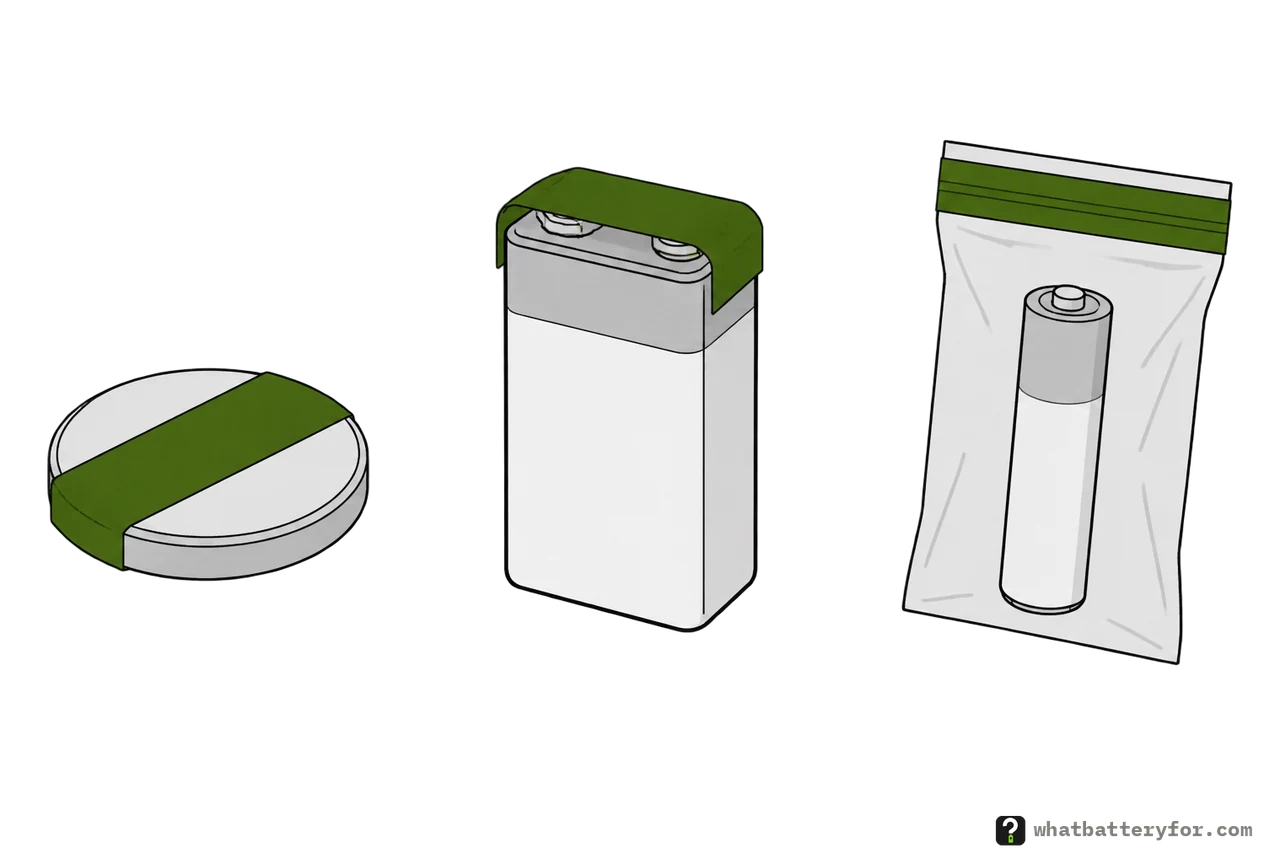
If anyone may have swallowed a button or coin battery, call the National Battery Ingestion Hotline at 1-800-498-8666 straight away. Keep spare and used coin cells where children can’t see or reach them.
If a battery is swallowed
The National Capital Poison Center says that if anyone swallows a battery, immediately call the 24-hour National Battery Ingestion Hotline at 1-800-498-8666 or your poison center at 1-800-222-1222. Don’t delay. Immediate treatment decreases severity. Its battery page also says:
- Give the battery’s number if you can, from the package or a matching battery.
- Don’t make the person vomit.
- If it was swallowed in the last 12 hours, especially if it may be a lithium coin cell, and the child can swallow, give 2 teaspoons of honey every 10 minutes on the way to the ER. Don’t give honey to a baby under 1. Don’t put off going to the ER to give honey, and give nothing else to eat or drink until an x-ray shows where the battery is.
- A battery stuck in the esophagus must come out fast: severe damage can happen in just 2 hours.
- A battery in the nose or ear can also cause permanent injury. Don’t use nose or ear drops until a doctor has seen the person.
The batteries behind most serious cases
The poison center says more than 3,500 people of all ages swallow button batteries each year in the United States. Large ones, especially 20 mm lithium coin cells, are behind most serious cases; their codes are often CR2032, CR2025 or CR2016, engraved on the cell.
Keeping them away from children
The National Capital Poison Center’s safety tips:
- Never leave batteries out. Store spares, and used ones waiting to be recycled, out of children’s sight and reach.
- Check that every battery compartment is shut tight, and tape any that a child can open or that might pop open if dropped.
- Choose products whose battery compartment needs a screwdriver or tool to open, or has a child-resistant lock.
- Don’t put in or change batteries in front of small children.
- Never put a battery in your mouth: they’re slippery and easily swallowed.
- Keep batteries away from pills and pill bottles, bedside tables and loose pockets.
- Make sure a child’s hearing aid has a child-resistant battery door, locked while it’s worn.
What Reese’s Law requires
| What | The rule | Since |
|---|---|---|
| Battery packaging | Child-resistant (special) packaging, under Section 3 of Reese’s Law | February 12, 2023 |
| Products that use the batteries | CPSC adopted UL 4200A-2023: a replaceable cell’s compartment needs a coin, screwdriver or other tool to open, with captive screws, or two independent hand movements at once | Rule effective October 23, 2023 |
| Warnings on battery packs | Include “Keep in original package until ready to use” and “Do NOT dispose of batteries in household trash” | Packaging made or imported after September 21, 2024 |
Reese’s Law exempts from the packaging rule batteries that meet the marking and packaging rules of the ANSI C18.3M standard.
Bitter coatings and other features
These are the makers’ own claims. Duracell says its CR2032, CR2025 and CR2016 have a non-toxic bitter coating on both sides, “designed to help discourage swallowing”. Energizer says its Ultimate Child Shield 2032 has a bitter coating, child-resistant packaging, a Color Alert dye that turns the mouth blue, and what it calls Ingestion Burn Protection.
Apple warns that some CR2032 batteries with bitterant coatings might not work with AirTag or other battery-powered products. Whatever the coating, the poison center’s advice for a swallowed battery is the same: call the hotline straight away.
Throwing them away
EPA says not to put button or coin batteries in the household trash or recycling bins. Put each one in its own plastic bag, or tape over its terminals or around the whole button, and take it to a battery recycler, a store that takes batteries back or a household hazardous waste collection.