On US flights, spare lithium batteries go in your carry-on, never a checked bag. Alkaline and NiMH batteries can go in either, with their ends protected from short circuit.
Battery
Packed
Flying with batteries
The FAA’s table
Batteries in passenger bags on US flights, from the FAA’s table
Battery
Carry-on
Checked
Limit
Alkaline (AA, AAA, C, D, button)
Yes
Yes
None
NiMH or NiCd rechargeable
Yes
Yes
None
Lithium metal, not rechargeable
Yes
Yes; spares carry-on only
2 g of lithium each
Lithium-ion in a device
Yes
Yes, switched off
100 Wh; 160 Wh with airline approval
Spare lithium-ion or power bank
Yes
No
100 Wh; two of 101 to 160 Wh with approval
Tracker such as an AirTag
Yes
Yes, within the limit
0.3 g lithium or 2.7 Wh to check it
Lithium battery powered generator
No
No
Over 160 Wh
From the FAA’s Airline Passengers and Batteries page (last updated October 2, 2026), read October 25, 2026. The FAA says TSA, airline and international rules may, at times, be more restrictive.
Working out watt hours
Newer lithium-ion batteries have the Wh rating printed on them. If yours shows mAh instead, the FAA says to divide the mAh by 1000 and multiply by the volts: a Fenix 3.6 V, 3400 mAh flashlight battery is 12.24 Wh. The mAh to Wh calculator does the sum.
Packing spares
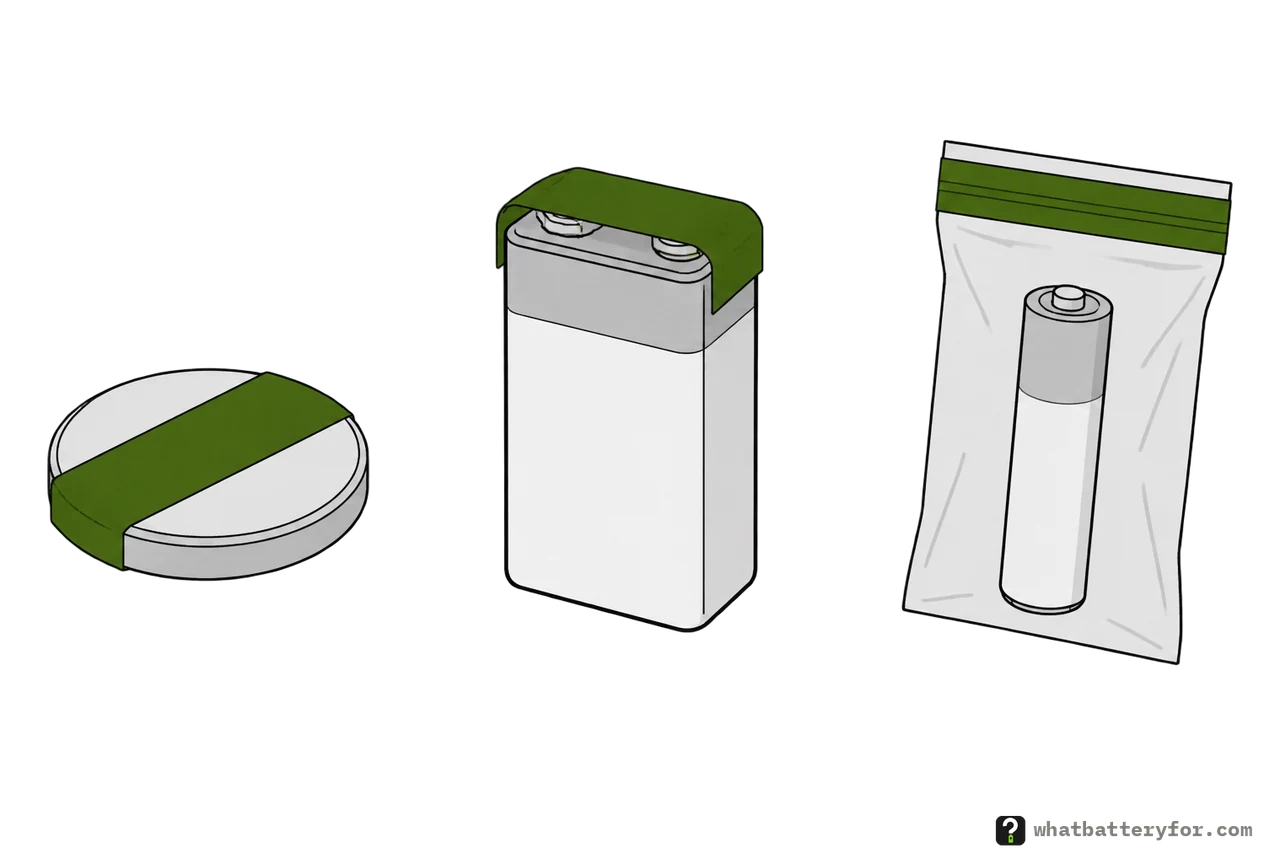
The FAA wants every spare battery’s ends kept from touching metal. Energizer’s travel tips say to keep spares in their original retail packaging; for loose ones, put a strip of insulated tape across the contacts, or each battery in its own case or plastic bag. A rechargeable battery left sitting in its charger doesn’t count, the FAA says.
Tapeacross the faceTapeover the terminalsOwn bag
For loose spares: tape across a coin cell’s face or over a 9V’s terminals, or each battery in its own bag.
Keep coin cells such as the CR2032 away from children while you travel. The National Capital Poison Center says that if anyone swallows a battery, immediately call the 24-hour National Battery Ingestion Hotline at 1-800-498-8666 or your poison center at 1-800-222-1222. Don’t delay. Immediate treatment decreases severity.
Damaged batteries and trouble in flight
Damaged or recalled batteries, and devices holding them, can’t fly in any bag unless the battery is removed or made safe. If a battery or device starts overheating, swelling, smoking or burning on board, the FAA asks passengers to tell the flight crew immediately.
For carry-on and personal item sizes by airline, see What Size Bag.
Common questions
Can I put AA batteries in my checked bag?
Alkaline and NiMH AA batteries, yes: the FAA's table allows them in carry-on and checked bags, with the ends protected. Spare lithium AA batteries go in carry-on bags only.
How many batteries can I take on a plane?
The FAA sets no quantity limit for most batteries, as long as they're for your own use. Spare lithium-ion batteries of 101 to 160 Wh are limited to two per person, and the FAA says airlines may set stricter limits.
What if my carry-on is checked at the gate?
The FAA says to take every spare lithium battery and power bank out of the bag and keep them with you in the cabin.
The rules come from the FAA’s PackSafe pages and its Airline Passengers and Batteries table, read on October 25, 2026; lithium content from Energizer’s L91 and L92 sheets and the packing tips from Energizer’s battery care page. Checked against published data from Energizer, FAA, National Capital Poison Center and Fenix.
See all 8 sources
National Capital Poison Center, Button battery ingestion (poison.org/battery)
Energizer, Battery Do's and Don'ts (battery care page)
Federal Aviation Administration, PackSafe: Lithium Batteries (last updated August 11, 2026)
Federal Aviation Administration, PackSafe: Batteries, dry cell (last updated January 22, 2025)
Federal Aviation Administration, Airline Passengers and Batteries (last updated October 2, 2026)
Fenix Lighting, ARB-L18-3400U and ARB-L21-5000 rechargeable battery product pages
Battery sizes come from battery makers' datasheets and device makers' own manuals and help pages. Check your device's manual or the old battery before you buy. If anyone may have swallowed a battery, call the National Battery Ingestion Hotline at 1-800-498-8666 or your poison center at 1-800-222-1222 straight away.